Predictable Income. Protected Lifestyle.
Most people spend decades saving for retirement — but saving is only half the journey. At a certain point, you have to get off the highway. The way you drive changes. You slow down, pay attention to what's around you, and navigate with intention. We help you make that transition with a retirement income strategy built for the road ahead — not the one behind you.
The two biggest retirement mistakes we see
Most pre-retirees have done the hard part — they saved. But saving in the right buckets is very different from drawing from those buckets in the right order. Without a withdrawal sequence and income floor strategy, even a well-funded retirement can run short — or cost far more in taxes than it should.
Staying on the highway too long:
Keeping a growth-only strategy through retirement exposes your income to sequence-of-returns risk — meaning a market downturn in your first few years of retirement can permanently reduce how long your money lasts, even if the market recovers.
No income floor:
Without guaranteed income sources covering your core expenses, every market drop becomes a crisis. An income floor strategy separates your "need to have" income from your "nice to have" income — so you never have to sell investments at the wrong time.
The Problem with “Hope-Based” Retirement
Income Floor Strategy
Sequence of Returns Risk
Using Annuities Strategically
Income Gaps
Sequence-of-returns risk: the retirement threat no one talks about enough
It's not just about average returns — it's about when those returns happen. Two retirees with identical average returns over 30 years can end up with dramatically different outcomes depending on whether the bad years came at the beginning or the end of retirement.
We address this by building a structured income layer — using guaranteed income sources to cover baseline expenses — so your market portfolio has time to recover without forcing early withdrawals.
Here's the problem: If your portfolio drops 25% in year two of retirement while you're still withdrawing income, you're selling more shares at a lower price to maintain your income level. Those shares are gone permanently — they never recover for you, even when the market does. This is why the transition window (the 5 years before and after retirement) is the most financially dangerous stretch of your entire retirement journey.
The 4% Rule
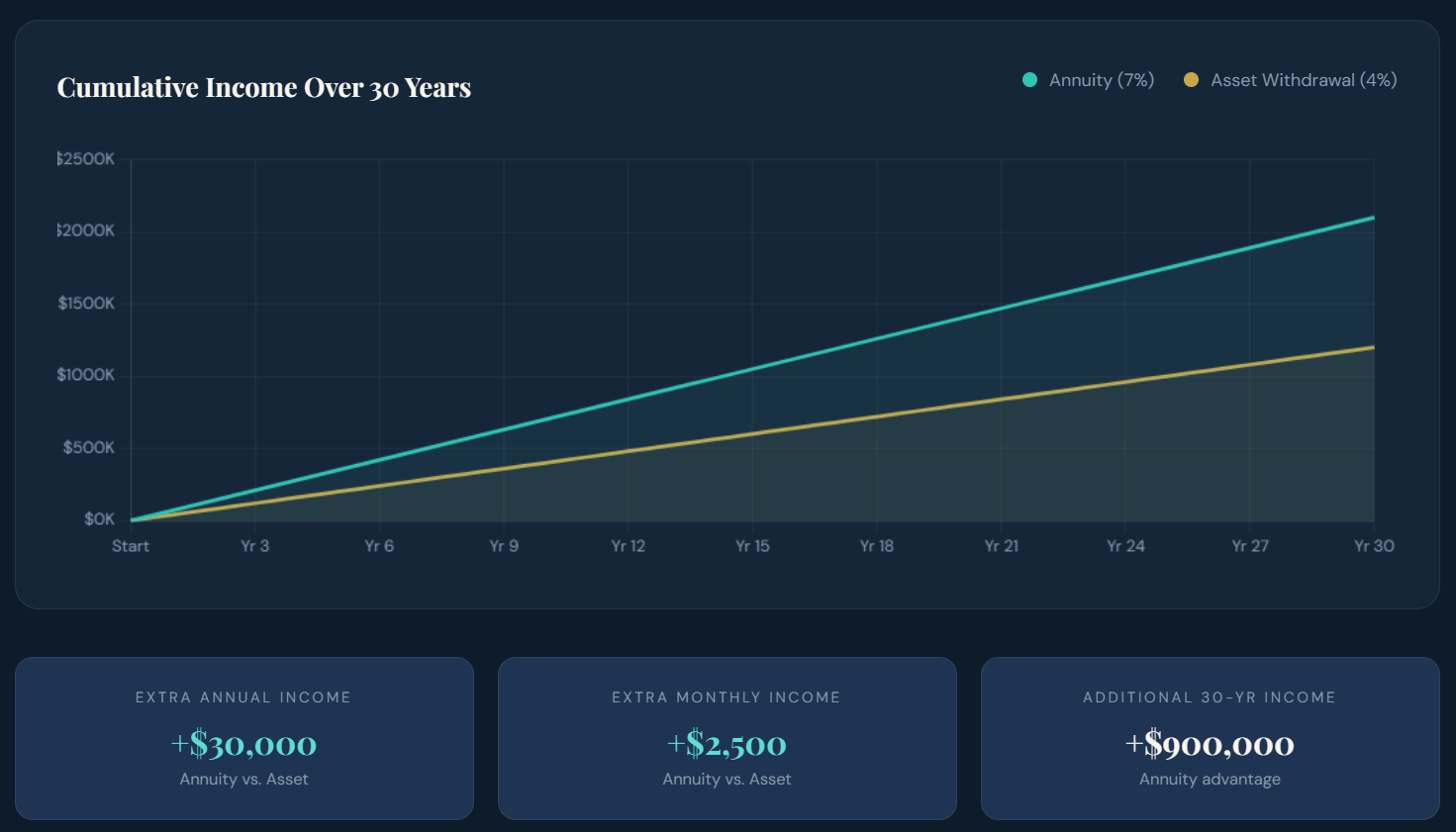
Most Advisors will advise to pull out 4% of your assets per year (and adjust for inflation). This would guarantee your assets would last 30 years for retirement.
Many people are retiring with 6-8% and guaranteed income for life.